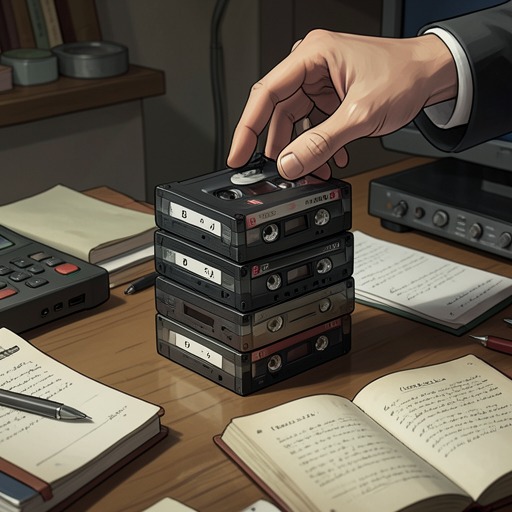
Clay received and began to listen to Hannah's tape
Thirteen Reasons WhyClay’s receipt of Hannah’s tapes begins the novel’s central chain of listening: a package left at his door becomes a numbered record of Hannah’s life and the reasons she says it ended. The tapes do not arrive as an explanation he can absorb all at once. Their fixed order, Hannah’s instructions, and the map he has already forgotten in his backpack make listening a process that unfolds over time and implicates each recipient in what comes next.
The package and its contents
The package is propped at an angle against the front door of Clay’s home, addressed to him in a hurried hand. Because the mail slot cannot admit anything thicker than a bar of soap, it has been left outside. Clay takes it into the kitchen, opens it with scissors, and finds a shoebox containing bubble wrap and seven loose audiotapes. Their physical arrival—unannounced and meant for him—turns an ordinary afternoon into the start of a disclosure.
Dark blue numbers mark the upper-right corner of each tape, with two numbered sides on each of the first six tapes and a thirteenth number on only one side of the last. The numbering gives the recordings an order before Clay knows their subject. He finds a way to play them on an old stereo in the garage, loading the first cassette and hearing Hannah introduce herself. The disclosure that she has died by suicide changes the package from a mystery into a message from someone who can no longer speak in person.
A recorded account with rules
Hannah presents the tapes as an account of her life, and more specifically of why it ended. She tells the listener that the people hearing them are among the reasons. For Clay, the recording’s address is both general and personal: it announces a chain of responsibility while revealing that he is one of its recipients. The voice on the tape is present through playback, but its account has been prepared and ordered in advance.
The instructions make the order binding. Each listener is to hear all thirteen sides, rewind the tapes, return them to the box, and pass them on to the next person. Hannah warns that the final listener may take them away, and says she made a copy that will be released publicly if the package does not pass through everyone. The recordings therefore function not just as testimony but as a system of circulation: listening is followed by a required handoff, while the possibility of a public copy backs that requirement with a consequence.
The form also makes time and access part of the account. The tapes must be heard side by side, and their numbered sequence controls when each part becomes available. Hannah’s recurring idea that there are thirteen sides to every story connects the material count to a claim about perspective: no single listener receives the whole account at once. Clay’s experience is consequently shaped by both what Hannah says and the practical conditions under which her voice reaches him.
The map and the city
The tapes are accompanied in Clay’s experience by a map Hannah had sent earlier. A few weeks before her death, someone slipped an envelope into his locker marked with a red instruction to save it. Inside was a city map bearing about a dozen red stars. Clay kept it in his backpack, intending to find out whether anyone else had received one, but it sank beneath his schoolbooks and notebooks until the arrival of the tapes made its purpose intelligible.
Hannah explains that the stars mark places listeners can visit for additional insight. She does not require them to go, and allows that they could throw the maps away, but the invitation extends the recordings beyond sound: the city itself becomes part of the route through her story. When Clay hears this, the map remains crushed at the bottom of his backpack, a neglected object suddenly connected to the testimony playing nearby. Its earlier arrival also establishes that Hannah’s plan was already reaching him before he understood that he was on the list.
Number nine and the continuing sequence
As Clay listens further, he identifies himself as number nine. In a car with Tony, he removes the fifth tape—the one marked with the dark blue number nine—and calls it his tape. The moment makes the earlier numbering concrete: the sequence does not merely organize Hannah’s account but locates Clay within the chain and marks his place among its intended listeners.
Later, while listening to the seventh cassette, side B, the tape reaches the end of its spool and clicks over before continuing. Its mechanical transition draws attention to the medium itself: Hannah’s voice has accompanied Clay across seven tapes and thirteen stories, with a faint static hum underneath. The recordings’ physical limits—numbered sides, spools, playback, and transfer—remain visible as the account proceeds. Clay’s act of listening is therefore not a single encounter with a finished explanation, but a sustained passage through Hannah’s arranged testimony and the obligations attached to it.
Narrative significance
The event establishes the novel’s central narrative arrangement: Clay hears Hannah’s recorded voice while the reader encounters her account through the same sequence of tapes. The recordings supply a first-person voice from beyond Hannah’s death, while Clay’s reactions keep the act of listening anchored in the present of the story. Their alternating presence creates an interval between what Hannah has recorded and what Clay is only beginning to understand.
The package, map, numbered sides, and threatened public copy make the testimony both intimate and procedural. Hannah’s voice is directed to specific listeners, yet the copy means it could reach a wider public if the chain fails. The central tension is built into that design: a private account must be transmitted in order, and each listener receives not only information but a place in the sequence. For Clay, opening the package is the first step into that responsibility.